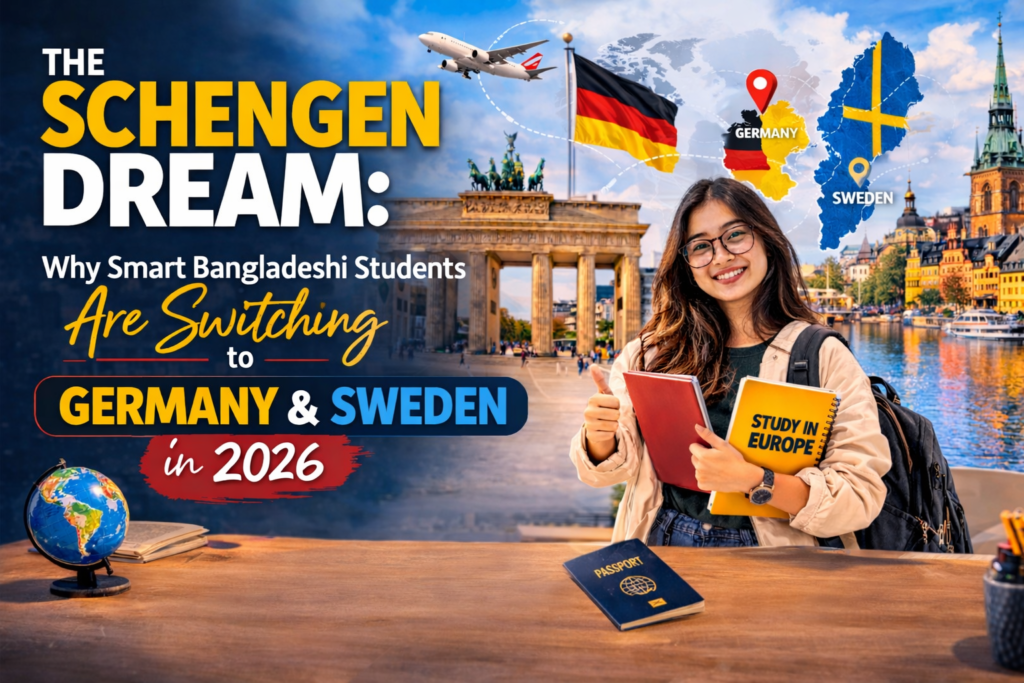
The Schengen Dream: Why Smart Bangladeshi Students Are Switching to Germany & Sweden in 2026
For decades, the Bangladeshi “Study Abroad” roadmap has been a straight line: London, New York, Toronto, or Sydney. We are obsessed with the Anglosphere. We speak English, so we want to go where English is spoken.
But in 2026, the cracks are showing.
- UK: High tuition fees and strict dependent rules.
- Canada: Housing crisis and cap on visas.
- Australia: Expensive and difficult for older students.
- USA: High risk of visa refusal.
While everyone is fighting for a seat in these countries, a quiet revolution is happening. Smart students, the ones who do deep research—are looking East. They are looking at the Schengen Zone.
Specifically, they are looking at Germany and Sweden.
Why? Imagine a country where university tuition is 100% Free. Imagine a country where your spouse gets a visa automatically and can work full-time. Imagine a visa that lets you travel to Paris, Rome, and Barcelona on your weekend without any extra paperwork.
This is not a fantasy. This is Europe. However, the process is completely different from the UK or USA. There are “Blocked Accounts,” “Uni-Assist,” and “Personnummer” to deal with. In this comprehensive guide, we will unlock the secrets of Central and Northern Europe. We will compare the two giants—Germany and Sweden—and show you how to build a career in the EU.
The “Schengen” Advantage
First, let’s explain the biggest perk. The Schengen Area consists of 29 European countries that have abolished their internal borders.
- The Visa: When you get a student residence permit for Germany or Sweden, you effectively get a travel pass for the whole continent.
- The Lifestyle: You can have breakfast in Munich, take a train, and have dinner in Prague. For a student who wants to see the world, there is no better base than Europe.
Contender 1: Germany (The Land of Free Education)
Germany is the economic engine of Europe. It is famous for Engineering, Automobiles (BMW, Mercedes), and Innovation.
1. The “Free Tuition” Reality Is it really free? Yes.
- Public Universities: Most public universities in Germany charge ZERO tuition fees for Bachelor’s and Master’s degrees—even for international students.
- Semester Contribution: You only pay a small administrative fee (approx. €200 – €300 per semester), which usually includes a free public transport ticket.
- The Savings: Compared to the UK (where you pay £16,000/year), you are saving nearly 25 Lakh BDT on tuition alone.
2. The “Blocked Account” (Sperrskonto) If tuition is free, what do you pay? You pay for your living costs upfront. Germany requires you to deposit money into a Blocked Account (e.g., Fintiba, Expatrio).
- Amount (2026 Est): Approx. €11,904 (approx. 15-16 Lakh BDT) for one year.
- How it works: You deposit the money. The bank “blocks” it. Once you arrive in Germany, they release ~€992 back to you every month for your rent and food.
- Why it’s good: Your parents don’t need to send money monthly. Your living cost is already secured.
3. The Language Barrier Myth “But Bhaiya, I don’t speak German!”
- For Bachelor’s: Yes, most courses are in German. You need C1 level. Hard for beginners.
- For Master’s: Good News! Thousands of Master’s degrees (especially in Engineering, IT, Business, and Data Science) are taught 100% in English. You do not need to know German to study.
- Career Tip: However, to get a job after graduation, learning basic German (A1/A2) is highly recommended.
4. Post-Study Work & PR
- Job Search Visa: After graduating, you get 18 months to find a job.
- PR (Settlement): If you find a job related to your degree, you can get Permanent Residency (Niederlassungserlaubnis) in just 2 years. This is one of the fastest PR routes in the world.
Contender 2: Sweden (The Family Paradise)
Sweden is the home of IKEA, Spotify, and Volvo. It is a modern, progressive, and incredibly beautiful Scandinavian country.
1. Tuition Fees (Not Free, But Reasonable) Unlike Germany, Sweden charges tuition for non-EU students.
- Cost: Approx. SEK 80,000 – 140,000 per year (approx. 9-15 Lakh BDT).
- Scholarships: The SI Scholarship and university-specific waivers can cover 50% to 100% of fees for high achievers.
2. The “Spouse” Superpower This is why mature Bangladeshi students love Sweden.
- The Rule: If you are admitted to a program of 6 months or more (e.g., a Master’s), your spouse (husband/wife) gets a Residence Permit too.
- Work Rights: Your spouse gets Full-Time Work Rights from Day 1. They don’t need a job offer to get the visa. They can land and start working immediately.
- The Math: If your spouse works full-time in Sweden (where wages are high), they can easily cover your tuition fees and family living costs.
3. No Language Barrier Sweden is ranked #1 in the world for English proficiency as a second language.
- Everyone speaks English. The bus driver, the cashier, the doctor.
- You can live, study, and work in Sweden for years without learning a single word of Swedish (though learning helps socially).
4. The PR Route
- Work Permit: After graduation, you get 12 months to find a job.
- PR: After working for 4 years, you get PR.
- PhD Bonus: If you do a PhD in Sweden (4 years), you are eligible for PR immediately upon graduation.
Admission Process: The “Central” Systems
Applying to Europe is different from the UK/USA. You don’t usually apply to universities individually.
Germany: Uni-Assist
- Most universities use a portal called Uni-Assist.
- VPD: You upload your Bangladeshi documents. Uni-Assist verifies them and converts your CGPA to the “German Grading System” (where 1.0 is the best and 4.0 is the lowest).
- Cost: You pay per application (approx. €75 for the first one, €30 for subsequent ones).
- Timeline: German universities are slow. Apply at least 4-5 months before the deadline.
Sweden: UniversityAdmissions.se
- This is a centralized portal for all Swedish universities.
- Limit: You can apply to 4 Master’s programs in one application.
- Ranking: You must rank them in order of preference. If you get into your #1 choice, the others are deleted. Be strategic!
- Deadline: The main deadline is usually mid-January for the September intake. If you miss this, you miss the year.
Document Checklist (The European Way)
Europeans love paperwork. Your file must be perfect.
- IELTS:
- Germany: Usually requires 6.5 overall (some accept 6.0).
- Sweden: Requires 6.5 (no band less than 5.5).
- MOI Waiver: Some German universities accept “Medium of Instruction” letters if your Bachelor’s was in English, but this is becoming rarer. IELTS is safer.
- Letter of Motivation (LOM): Similar to an SOP, but shorter and more focused on why this specific course. No emotional stories; just academic facts.
- CV (Europass Format): Do not use your American or Bangladeshi CV. Use the Europass standard format (photo in top corner, specific layout).
- Course Description: (Crucial for Germany). You might need to submit a syllabus of your Bachelor’s degree to prove you have enough “credits” in Math/Statistics to qualify for the Master’s.
The Visa Interview: Relaxed but Logical
Germany:
- You go to the German Embassy in Dhaka.
- It is usually a document check, but they might ask basic questions: “Why this city? What modules will you study?”
- Waiting Time: The visa appointment wait time for Germany can be long (sometimes months). You must book the slot as soon as you get the admission letter.
Sweden:
- The process is mostly online.
- You upload documents to the Migration Agency website.
- Interview: Usually, there is no interview for student visas unless they find something suspicious. You just go to the embassy to give biometrics (fingerprints).
Living in Europe: Expectation vs. Reality
1. Housing is Hard
- In cities like Munich, Berlin, or Stockholm, finding an apartment is a war.
- Tip: Apply for student dormitories (Studentenwerk) the second you apply to the university. Waiting lists can be 6 months long.
2. Cultural Vibe
- Germany: Punctuality is religion. Rules are strict. Sundays are silent (shops are closed). People are direct and honest (they don’t do “small talk”).
- Sweden: Egalitarian. “Lagom” (just the right amount) is the philosophy. Work-life balance is amazing (5 weeks holiday is standard).
3. Part-Time Work
- Germany: You can work 140 full days or 280 half days per year. Minimum wage is approx. €12.41/hour.
- Sweden: Unlimited work hours allowed for students (as long as you pass your exams). But finding a job without Swedish can be tough outside major cities.
Who Should Choose Europe?
Choose Germany if:
- You are an Engineer or IT Professional.
- You have a limited budget (cannot afford £15k tuition).
- You are organized, disciplined, and willing to learn a new language for a high-paying career.
Choose Sweden if:
- You are Married and want to bring your spouse immediately.
- You want a relaxed, English-speaking environment.
- You are interested in Sustainability, Design, or IT.
- You have a higher budget for tuition but want high returns on family income.
Common Myths Busted
Myth: “Education is free, so the visa is easy.” Fact: False. Because it is free, competition is insane. German universities reject thousands of students. Your CGPA matters immensely. A CGPA below 3.0 makes admission very difficult for public universities.
Myth: “I can go to Germany and move to UK.” Fact: No. A Schengen visa does not give you entry to the UK (which is outside Schengen).
Myth: “I can survive on part-time jobs alone in Sweden.” Fact: Rent is high. While you can work, relying 100% on it is risky. You need the initial funds to survive the first 3-4 months.
How IECC Helps with Europe
Europe is complex. One mistake in the “Course Description” mapping or the “Blocked Account” transfer can ruin your intake. IECC has a dedicated Europe Desk.
What We Do:
- Credit Mapping: We check your Bachelor’s transcript against the German university requirements to see if you are eligible (e.g., “Do you have 15 ECTS in Math?”).
- Uni-Assist Handling: We manage the complex Uni-Assist portal for you.
- Blocked Account Setup: We guide you on how to transfer money from Bangladesh to Fintiba/Expatrio legally.
- Europass CV: We edit your CV to match the European standard.
Conclusion: The Road Less Traveled
Choosing Germany or Sweden is a bold move. It means stepping away from the “easy” English path. It means dealing with euros, kronor, and strange new languages.
But the rewards are incredible. You graduate debt-free (in Germany). You gain a foothold in the world’s largest economy. You build a life in societies that value work-life balance and innovation.
If you are smart, ambitious, and looking for a career—not just a degree—Europe is calling.
Germany or Sweden? Free Tuition or Spouse Visa? Which one wins for you? Tell us here : 01885 990 990