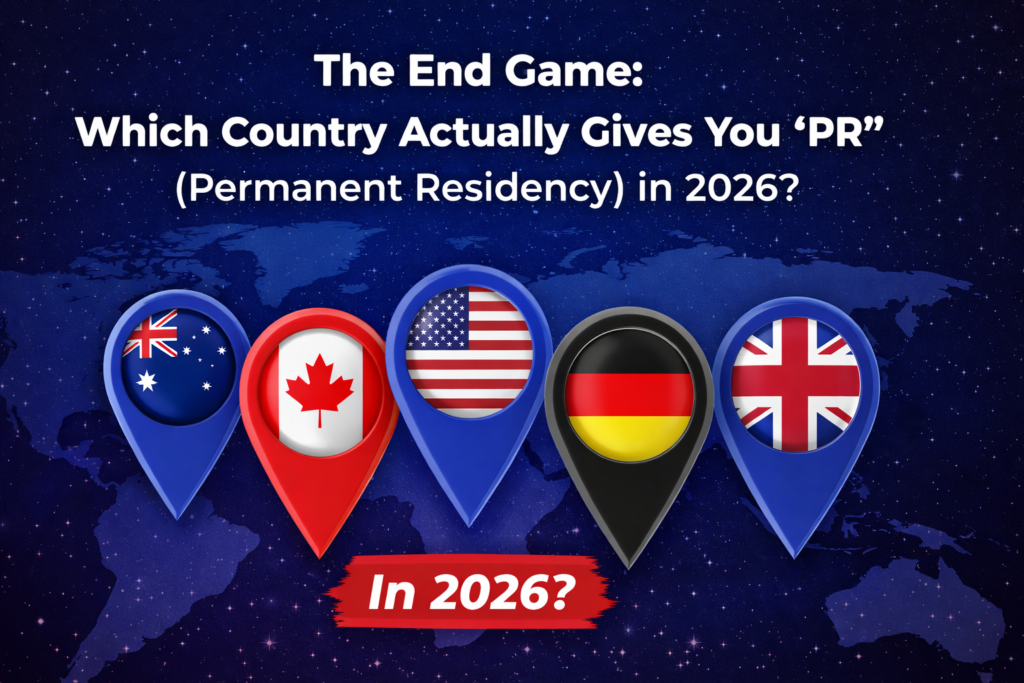
The End Game: Which Country Actually Gives You “PR” (Permanent Residency) in 2026?
Let’s be honest for a moment.
When you walk into our office, you talk about “Ranking,” “Tuition Fees,” and “Campus Facilities.”
But deep down, in the back of your mind, you are thinking about something else.
“Can I stay there forever?”
For many Bangladeshi students, studying abroad is not just about the degree. It is about Settlement. It is about building a life in a country with better healthcare, safety, and career opportunities. It is about the coveted “Blue Passport” or “Red Passport.”
But in 2026, the PR (Permanent Residency) game has changed.
- Canada is no longer the “walk-in” PR haven it used to be.
- The UK gives you a work visa, but no clear path to settlement.
- Australia is inviting you, but only if you move to the “bush” (regional areas).
- The USA remains a high-stakes lottery.
If your ultimate goal is PR, choosing the wrong country—or the wrong city within that country—can cost you 50 Lakhs and 5 years of your life. You might graduate with a Master’s degree only to be told: “Thank you, now go home.”
In this strategic guide, we will strip away the marketing fluff and look at the hard immigration laws. We will compare the Big Four (UK, USA, Canada, Australia) and the European Wildcards to tell you exactly where you should go if you want to stay.
Country 1: Canada (The “Points” Game)
For the last decade, Canada was the undisputed King of PR.
“Go to Canada, get PR in 3 years.” That was the slogan.
In 2026, the door is still open, but the queue is much, much longer.
The Pathway: PGWP -> CRS Score -> PR
- Study: You complete a 2-year Master’s or Diploma.
- Work: You get a 3-Year Post-Graduation Work Permit (PGWP).
- Apply: You gain 1 year of Canadian work experience. Then you enter the “Express Entry” pool. You are given a CRS Score (based on age, English, education, experience).
- Draw: The government picks the highest scores.
The 2026 Reality Check:
The competition is brutal. There are so many international students in Canada now that the “Cut-off Score” for PR has skyrocketed. Just having a generic diploma and a retail job is no longer enough.
How to Win in Canada:
- Learn French: This is the cheat code. If you can pass a French test (TEF), your CRS score jumps massively.
- Choose STEM or Healthcare: Canada does “Targeted Draws.” If you are a Nurse, Engineer, or Tech worker, they will pick you even with a lower score.
- Go Provincial (PNP): Forget Toronto (Ontario) and Vancouver (BC). Go to Saskatchewan, Manitoba, or Atlantic Canada (Nova Scotia). Their Provincial Nominee Programs (PNP) are much easier. Buying winter clothes is a small price to pay for a passport.
Verdict: Still the clearest path, but only if you are strategic about where you live and what you study.
Country 2: Australia (The “Regional” Strategy)
Australia wants migrants, but they don’t want them in Sydney or Melbourne.
They want you in Adelaide, Perth, Darwin, or Hobart.
The Pathway: Subclass 485 -> SkillSelect -> PR (Subclass 189/190)
- Study: Complete a 2-year degree (Bachelor’s/Master’s).
- Work: Get the Temporary Graduate Visa (Subclass 485). This gives you 2-4 years to work.
- Points Test: Like Canada, you get points for Age, English (PTE 79+ is essential), and Education.
The 2026 Reality Check:
Getting a “189 Independent Visa” (where you can live anywhere) is extremely hard for accountants and IT pros.
However, the “190 State Nominated” and “491 Regional” visas are gold mines.
How to Win in Australia:
- Study in a Regional Area: If you study in Perth (which is a city, but counted as regional) or Gold Coast, you get extra points and an extra year on your work visa.
- The “Professional Year” (PY): After graduation, pay to do a PY course (internship + training). It gives you 5 extra PR points.
- Naati: Take a translator test (Bengali to English). Another 5 points.
Verdict: Excellent for Engineers, Nurses, and IT professionals who are willing to live outside the big two cities.
Country 3: United Kingdom (The “Cash Trap”)
The UK is tricky. It is enticing, but deceptive.
The Pathway: Student -> Graduate Route -> Skilled Worker -> ILR
- Study: 1-year Master’s.
- Work: You get the Graduate Route (PSW) visa for 2 years. You can work any job (waiter, driver, manager).
- The Cliff Edge: After 2 years, your visa expires. To stay, you MUST find a company to sponsor you on a Skilled Worker Visa.
The 2026 Reality Check:
The Graduate Route does NOT count towards the 5 years needed for Indefinite Leave to Remain (ILR/PR). It is a “pause button.”
Finding a “Sponsor” is hard. Companies have to pay extra fees to hire you. Unless you are in a shortage list (Care, Engineering, Tech), many companies prefer hiring locals.
How to Win in the UK:
- Care Sector: If you are willing to work in Health & Social Care, getting a sponsorship is relatively easy.
- High Skills: Be brilliant at Coding, Finance, or Engineering.
- Don’t Relax: Do not spend your 2-year PSW working in a chicken shop. Use day one to hunt for a “Sponsorship Job.”
Verdict: Great for earning quick money (ROI), but the hardest “Big 4” country for guaranteed settlement.
Country 4: USA (The “High Stakes” Lottery)
The USA is not for the faint-hearted.
The Pathway: F1 -> OPT -> H-1B -> Green Card
- Study: Complete your degree.
- Work: Get OPT (1 year or 3 years for STEM).
- The Lottery: Your employer applies for an H-1B Visa for you. It is literally a lottery. A computer picks names.
- Green Card: Once on H-1B, your employer files for your Green Card. This takes years.
The 2026 Reality Check:
If you don’t get picked in the H-1B lottery (about 25-30% chance), you have to go home.
However, if you do make it, the rewards are unmatched. US salaries are double what you get in UK/Canada.
How to Win in the USA:
- Do a STEM Degree: You get 3 attempts at the lottery (over 3 years of OPT).
- Be Exceptional: If you are a PhD or a top researcher, you can apply for an O-1 Visa (Extraordinary Ability) or EB-2 NIW (National Interest Waiver), skipping the lottery entirely.
Verdict: High Risk, High Reward. Go for the career, stay for the Green Card if you get lucky.
The “Wildcards”: Europe (Germany & Sweden)
Smart students are looking at Europe.
Germany
- The Deal: Education is free/cheap.
- PR Path: If you graduate from a German uni and work for 2 years, you get Permanent Residency.
- The Catch: You MUST speak German (B1/B2 level). If you refuse to learn the language, you will struggle.
Sweden
- The Deal: English-speaking society. High tech.
- PR Path: Work for 4 years to get PR.
- Doctoral Bonus: If you do a PhD in Sweden (4 years), you get PR automatically upon graduation.
Verdict: The hidden gems. If you are willing to learn a language, Germany offers the fastest, cheapest PR path in the world.
Comparative Table: The “PR” Scorecard
| Feature | Canada | Australia | UK | USA | Germany |
| Study Cost | Medium | High | Medium | High | Low |
| Post-Study Visa | 3 Years | 2-4 Years | 2 Years | 1-3 Years | 1.5 Years |
| Settlement Path | Points (Express Entry) | Points (SkillSelect) | Employer Sponsor | Lottery (H-1B) | Work 2 Years |
| Difficulty | Medium/Hard | Medium | Hard | Very Hard | Easy (if Language known) |
| Passport Time | ~4-5 Years | ~5-6 Years | ~6-7 Years | ~10+ Years | ~5-8 Years |
The “IECC Strategy”: Which One Fits You?
Profile A: The “Safe Player”
- Goal: “I just want a foreign passport to secure my family’s future.”
- Recommendation: Canada (PNP routes) or Australia (Regional).
- Why: The rules are clear. If you follow the checklist (study in Saskatchewan, learn French, or move to Adelaide), you will get PR. It is predictable.
Profile B: The “Money Maker”
- Goal: “I want to earn 5 Crores in 5 years. I don’t care about the passport right now.”
- Recommendation: USA (STEM).
- Why: The salaries are insane. Even if you have to come back after 3 years, you return rich.
Profile C: The “Academic / Quick ROI”
- Goal: “I have a limited budget. I want a Master’s quickly and to work for a few years.”
- Recommendation: UK.
- Why: 1-year Master’s means low investment. 2-year work permit means quick earning. If you get PR, great. If not, you still profited.
Common Mistakes Students Make
- Following the Herd: “My friend went to London, so I will go to London.” (Your friend might be struggling. Don’t copy blindly).
- Studying the Wrong Course: Studying “Business Administration” in Australia is useless for PR. Studying “Social Work,” “Nursing,” or “Civil Engineering” is gold. Check the Skilled Occupation Lists before you choose your major!
- Ignoring the Language: Thinking “I can survive with English in Germany.” You can survive, but you won’t get PR.
Conclusion: Begin with the End in Mind
Stephen Covey said, “Begin with the end in mind.”
If your end goal is PR, your strategy starts today, before you even apply to a university.
You need to pick the right country, the right state, and the right course.
Don’t let an agent sell you a “Dream.” Ask for the “Data.”
At IECC, we don’t just look at university rankings. We look at Migration Trends. We tell you: “If you study this course in this city, your PR chances are 80%.”
This is your life. Plan it like a CEO, not a tourist.
Book a “PR & Settlement” Strategy Session:
Which passport do you dream of holding? The Blue US one or the Red Canadian one? Tell us here: 01885 990 990